How to Read the Aurora Forecast in Lapland
What the Finnish aurora tools show and what they cannot: FMI's R-index, NOAA's Kp, the cloud forecast, the time of night and the months, explained.
Two things decide whether you see the northern lights in Lapland: whether the aurora is active, and whether the sky above you is clear. The aurora tools answer the first, and only for the next hours. The second is a weather question, and on a cloudy night it decides everything.
No forecast can tell you that a given night will show the lights. What the tools can do is tell you what is happening now, and what is likely over the next few hours.
The R-index: what the magnetic field is doing now
The Finnish Meteorological Institute’s aurora page shows the R-index, which “measures the rate of change of the magnetic field within a 10-minute interval”, from its automatic magnetometer stations across Finland. The Sodankylä readings come from the University of Oulu’s Sodankylä Geophysical Observatory.
Each station has two thresholds. When only the lower one is crossed, the bar turns yellow: auroras are possible but usually dim. When the upper one is crossed, the bar turns red, and auroras are very likely visible.
It is a reading of the present, not a forecast. A red bar at 22:00 tells you the field is active at 22:00, at that station. The institute’s space-weather site, RWC Finland, adds images from all-sky cameras.
The Kp index: the global three-hour number
Many apps show NOAA’s Kp index instead. The Space Weather Prediction Center rates disturbance of the Earth’s magnetic field from 0 to 9 over three-hour intervals, averaged across 13 observatories; 1 is calm, and 5 or more is a geomagnetic storm (G1). The Finnish odds of roughly half of dark, cloudless nights in Lapland show that it does not take a storm there, so a low Kp is no reason to stay in. We do not print a Kp value “needed” for Rovaniemi, because none of the issuers gives one.
Cloud: the forecast that decides
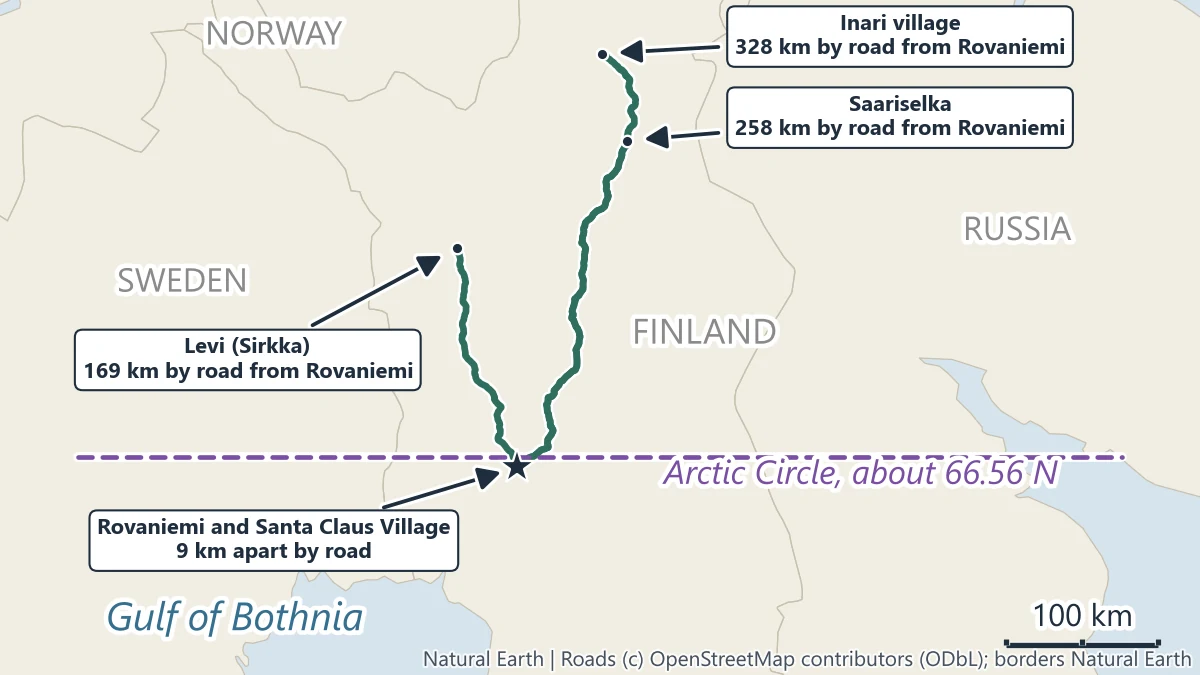
The institute’s own advice for watching auroras starts with the sky: a dark, open place far from town lights, a clear view at least towards the northern horizon, and a dark and cloudless night, which “is practically always cold in Finland”. Its odds for Lapland, roughly 50% of nights at resorts such as Levi and Saariselkä, count only dark, cloudless nights.
So read the cloud forecast for the evening before anything else, and look at where the clear patches are, not only at your own town. That is what the hunts from Rovaniemi do: BookLapland's guides read cloud radar and aurora data and drive up to 200 km or more, and Polar Lapland Oy chases clear sky 120 km away or across the border into Sweden when it needs to.
The hours and the months
The institute gives midnight, and a couple of hours before and after, as the typical time for auroral displays, and its questions page puts the best time between 9 p.m. and 1 a.m. local time. Its two pages differ on the months: one gives February to March and September to October, the other, “considering also the weather”, March and early April. In summer, the institute adds, the nights are generally too light.
Darkness ends early in spring. In Rovaniemi the sky is fully dark from 21:22 on 15 March 2027; on 1 April full dark lasts only from about 00:09 to 02:31, and by 15 April there is no astronomical night at all (computed for Rovaniemi, Finnish time).
What the forecast cannot tell you
The institute separates statistics, which say how often auroras occur through the year, from nowcasts and short-term forecasts based on space-weather monitoring. Neither says what you will see from one spot on one evening. The lights can be faint to the eye and stronger on a camera’s long exposure.
The hunts decide on the day as well. Experience Tours Lapland cancels by 4:00 PM with a full refund if the weather rules out the hunt, and Lapin Taivas Arctic Expeditions may cancel, with a full refund or another date, when there are no clear areas within 350 km. A cancelled night is a forecast at work, and the reason to book early in a stay, as which night to book explains.
More from Lapland
Aurora and Winter Tours with Open Dates
Other northern lights hunts and winter evenings in Lapland with live availability. Where each starts, what it includes and the cancellation terms show before you book.
A Hunt That Follows the Cloud Forecast
BookLapland's guides read cloud radar, solar wind and aurora data on the day and drive towards the clearest sky, up to 200 km or more if needed.
See dates